
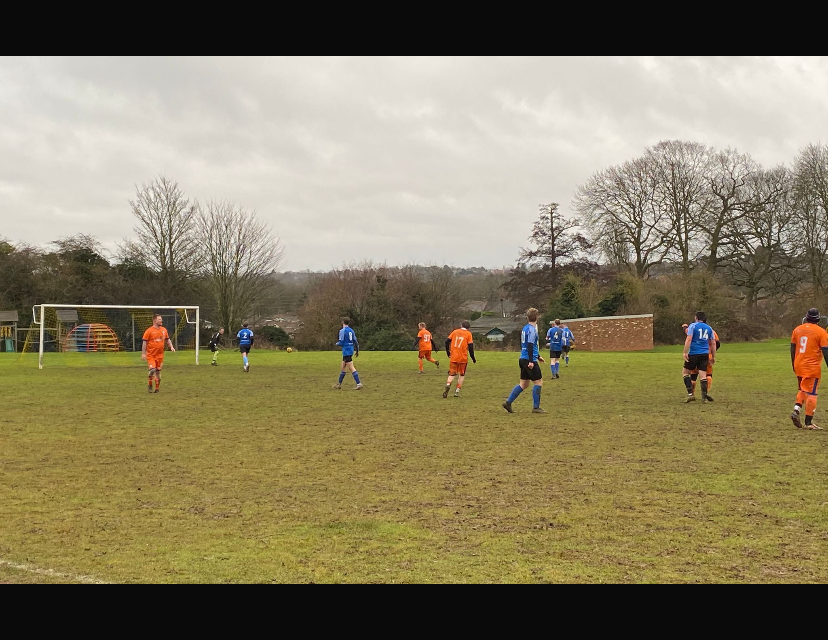
Sands United FC is a group that brings bereaved men together through football. Writer, Amina Ali speaks to two members, Nathan and Gary, about how they use the games to process their grief.
Amy and Emma both remember the day they lost their sons.
August. 2021 and 2024. In an overly lit surgical room, faceless doctors injected both women to end their pregnancies.
Amy’s son, Rossie, was found to have no kidneys. Emma’s son, Hudson, had several holes in his heart. It was the hardest decision they ever had to make, but they didn’t make it alone.
Outside the rooms sat their partners, Nathan and Gary.
This is the story of two men, two baby boys, and how football saved them.
Sands United FC is a football team made up solely of men who have lost a baby and has been offering support since 2018.
32-year-old Nathan Johncock joined Sands in September 2021, almost a month after the birth and death of his son, Rossie.
It was during Rossies’ 12-week scan that the sonographer noticed an anomaly.
Nathan explains: “The lady who was doing the scan kept asking Amy – my partner at the time – ‘are you sure your waters haven’t broken?’ And we were like, ‘no, definitely not. What’s going on?’”
There was no amniotic fluid around baby Rossie, which was unusual. It meant that the sonographers found it difficult to take measurements, as the fluid is crucial to allow a baby to develop.
A lack of fluid also meant that baby Rossie had no kidneys. None at all.
After another scan a few days later, Nathan and Amy both had to face news that no one ever wants to hear. Their baby had bilateral renal agenesis, a rare condition where both kidneys don’t develop.
“They said ‘these are your options. If you go full term and there are no kidneys, then the chance of living is very very slim. If they do live, then they are not going to be able to live long,’” says Nathan.
“They said it could be a minute, an hour, a day.”
Amy and Nathan decided to have a medical termination, also known as ‘ground E abortions.’ The most recent stats from the government say over 3,000 of these abortions are performed a year.
30-year-old Gary Pritchard, who is also a part of Sands United, and his partner Emma had a medical termination in August 2024. Their son, Hudson, had several holes in the heart which resulted in him getting weaker and weaker with each scan.

“It doesn’t get spoken about, a termination for medical reasons, because why should it? Every pregnancy you hear is always good news,” Gary says.
“But sometimes in life you get choices. Good ones or bad ones. And sometimes the only choices you have in front of you are the two bad choices. You still have to pick one.”
Emma and Gary’s pregnancy journey was not a quick or a simple one. It took scan after scan after scan to figure out what was wrong with Hudson. When they eventually did find out, the process to termination was frustrating.
After the terminations, both couples still had to go through the trauma of labour. Thankfully, both couples also had access to private rooms, away from the maternity ward to give birth in peace.
Gary explains, “they try to make it as nice as possible and put a lot of support books out from Sands.
He adds, “Emma was an absolute trooper. She didn’t want me in the room to experience what was happening. She was protecting me still. Her mum stayed with her.”
Nathan also remembers his partners experience at the time, feeling guilty that he couldn’t take the pain away from her.
He says, “It’s more different for the mums because I feel like they’ve got a different connection. They carry the baby, they feel the movements and they have a proper bond together where they pick everything up.
“Obviously, we don’t feel that way. We can see it and we can feel it with our hands, but it’s like a completely different feeling then when the baby is inside your belly.”
Amy and Nathan’s son, Rossie was born on the 19th of August 2021.
Emma and Gary’s son, Hudson was born on the 21st of August, 2024.
They can never forget. They never will.

“[Rossie] was born in the sac with the placenta over his face…so it was a difficult scenario where we actually didn’t know what he looked like,” Nathan says.
Babies being born still in their amniotic sac is very rare, and the process of cutting the sac open after birth is tedious.
“Once the sac was open, we could actually see what he looked like. His hands, and his feet, his toes and everything. That was really nice. Well, as nice as it can be.”
Gary remembers that Hudson “had cute little feet like his Mum, long legs like his Dad.”
He says, “We took pictures holding him. We didn’t take pictures of his face because his face, bless him, was a bit disfigured. His hands weren’t great either, they weren’t formed well. But he was still our little boy.”
“When you go through that, your emotions are running at 100 mile an hour,” Gary says.
Nathan and Gary were struggling to cope with their mental health, often taking out their frustrations in ways that, they admit, weren’t healthy.
“Because I struggled to cope with it and because I didn’t want to deal with the loss, I wasn’t able to be there for my wife, Amy, when she was trying to grieve,” Nathan says.
“I just used try and forget it, put it in the back of my head until an anniversary or birthday or Christmas came around.
“I realise now that I wasn’t able to be there for her as much as I should have, because I didn’t want to deal with it myself,” he says.
Gary says “my mental health started to get bad right before I got back to work. Then it got really bad over the work period.”
Both men’s path to Sands were very different. Nathan had been given a leaflet after leaving the private suite, showing the dates and times they had their meetings. Gary, however, was told about the group via an old school friend who had lost two of his children.
Monthly meetings became weekly team games with a community of men who had all gone through the same pain.

“You don’t even have to be amazing at football, you can be the worst person in the world. But it’s about being there, representing something bigger,” Gary says.
Being able to go “means a lot,” says Nathan.
“Even if I don’t talk about that, just being in that atmosphere with those guys helps a lot,” says Nathan.
“I go to these Sands meetings and games religiously now because it’s part of me,” Gary explains.
Gary goes on to say: “I used to play football many years ago, but I stopped. And now I’m playing at least once a week again. And it’s something that I enjoy.
“If it wasn’t thanks to Hudson, I wouldn’t see this side of the world. I wouldn’t see this side of life where not everything goes the way it’s meant to go.”
“Me and Amy always say it’s an amazing family that you don’t want to be a part of. The baby loss community is so far and wide and massive and it really is such a loving community to be involved in, but you don’t want to be involved in it because of that reason,” Nathan says.

Nathan and Gary both supressed their feelings, which many men are often told to do. Doing so made life more difficult than they can ever imagine, and so to them it is vital that other men don’t do the same.
“For any dad who’s lost a child or is going through it, and they go to the age-old stereotype that men have no feelings, please don’t listen to that. That stereotype is dead for a reason,” Gary says.
“It takes a lot of courage to admit that you want help and admit that you need help,” Nathan says.
“I’m going through counselling and therapy about all the stuff that’s happening. For me, you build everything up, put it all at the back of your head, and then there’s always a time where everything just goes crazy. You can’t cope with anything else and it comes out in some form of way.
“But getting help is one of the best things because it goes a long way,” Nathan says.
Nathan and Gary both urged all dads to follow the same piece of advice.
“Please don’t suffer in silence.”
If you’re a dad who’s interested in joining a Sands United team, you can find your local one here. Or for general information, you can visit the Sands website.
Alternatively, for other mental health support services you can visit the Mind website here.


